Think of kitchen hardware as just a finishing touch, and you’re missing its true power. The pulls and knobs you choose are less like a final coat of paint and more like the jewelry that defines an entire outfit—they can elevate the ordinary, anchor a theme, or create a jarring clash. That’s why the decision between brushed nickel, matte black, and brass hardware is one of the most consequential you’ll make in a kitchen design. These three finishes are the current design power players, each carrying a distinct personality that can either harmonize with your vision or work against it. Let’s move beyond the surface and explore how to match the right metallic character to your kitchen’s unique story.
The best way to choose between brushed nickel, matte black, and brass kitchen hardware is to first define your kitchen’s dominant style and color palette. For modern, minimalist, or high-contrast spaces, matte black creates a bold statement. Brushed nickel offers a versatile, cool-toned neutral that works with transitional, modern farmhouse, and contemporary styles. Brass (especially unlacquered or satin) brings warmth and vintage character, ideal for traditional, eclectic, or moody, saturated kitchens.
The Personality of Each Finish: More Than Just Color
Choosing between brushed nickel, matte black, and brass hardware isn’t just about picking a color; it’s about selecting the character that will define your space. Each finish carries a distinct aesthetic and emotional weight, influencing the entire room’s vibe. Understanding this core personality is the first step in your kitchen hardware finish comparison.
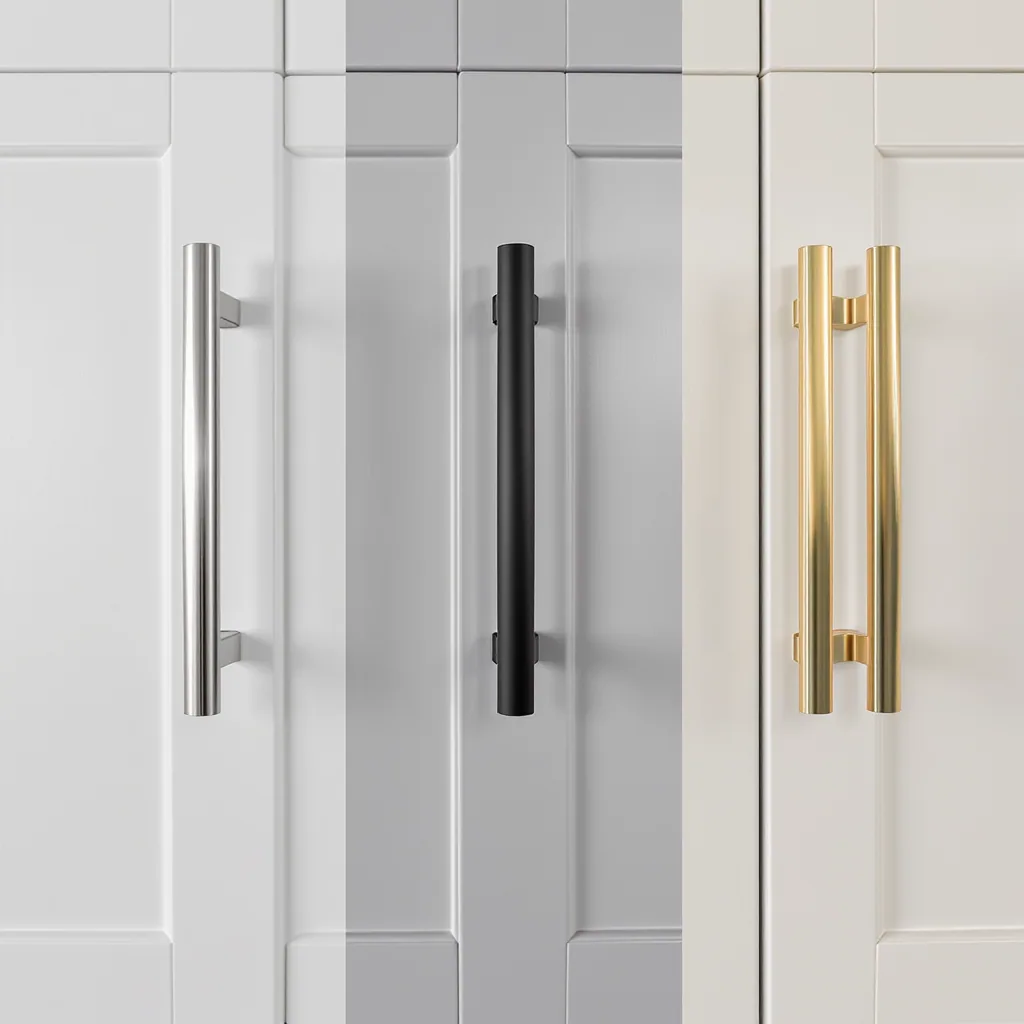
Let’s break down the defining traits of each contender in this classic brushed nickel vs matte black vs brass kitchen hardware debate.
| Finish | Aesthetic Vibe | Best For (Style) | Works With (Colors/Materials) | Durability & Care | Potential Drawback |
|---|---|---|---|---|---|
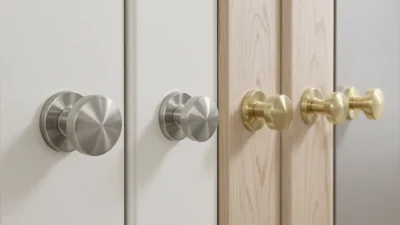
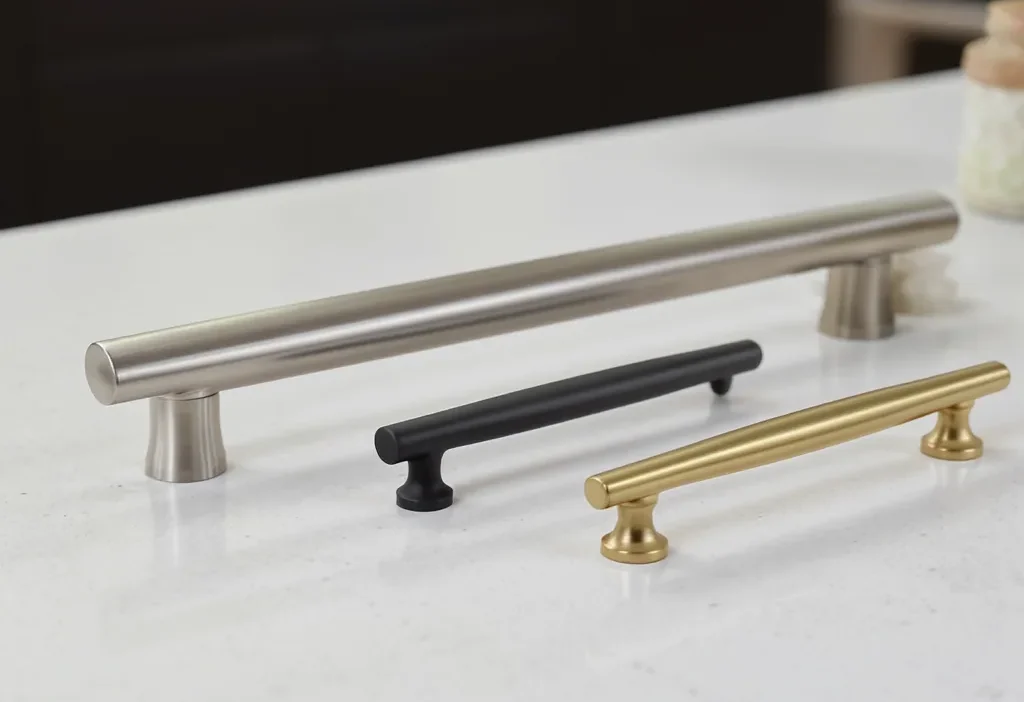
| Brushed Nickel | Cool, versatile, quiet luxury. The brushed texture softens reflections for a subtle, sophisticated look. | Transitional, Modern Farmhouse, Contemporary, Coastal. | Cool whites, grays, blues, stainless steel appliances, marble, quartz. Excellent for blending. | Very durable; the brushed texture hides fingerprints and water spots well. Easy to clean. | Can feel “safe” or lack personality in very bold designs. |
| Matte Black | Bold, modern, graphic. Creates high contrast and makes a definitive statement. | Modern, Minimalist, Industrial, Scandinavian. | White cabinets, dark woods, vibrant colors, concrete, and stone. Ideal for creating drama. | Powder-coated finishes are tough but can show fingerprints and dust more readily on flat surfaces. | Shows dust and fingerprints more than textured metals; can feel stark if overused. |
| Brass | Warm, vintage, rich. Adds instant warmth and a sense of history. Satin/unlacquered finishes feel more current than high-polish. | Traditional, Eclectic, Glam, Mediterranean, “Moody” modern spaces. | Warm whites, navy, green, wood tones, marble with veining. Complements other warm metals. | Varies: Lacquered brass resists tarnish. Unlacquered brass develops a patina over time, which many desire. | Unlacquered brass requires acceptance of changing color; polished brass shows water spots. |
Your Kitchen’s Style is the Ultimate Filter
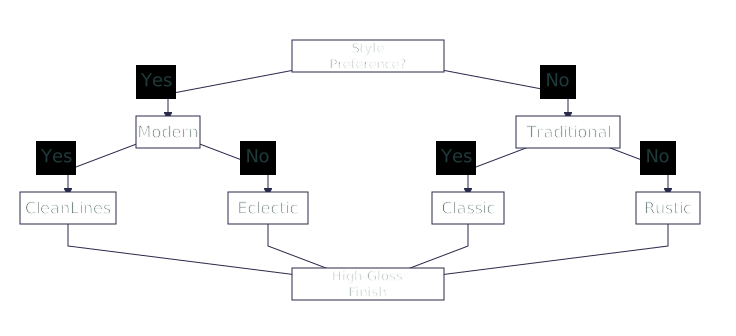
With the personalities defined, the most effective filter for your decision is your kitchen’s overarching style. Your cabinet pulls finish ideas should support and enhance this style, not fight against it. Think of it as matching the jewelry to the outfit.
For Modern & Minimalist Kitchens
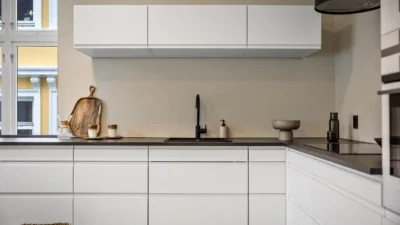
If your space features clean lines, flat-panel cabinets, and a restrained color palette, matte black cabinet pulls are your powerhouse. They act as crisp, graphic punctuation marks, creating beautiful contrast against white or monochromatic backgrounds. This finish embodies the “less is more” philosophy with maximum impact.
For Transitional & Modern Farmhouse Kitchens
This popular style blends traditional details with cleaner lines. Brushed nickel hardware is the quintessential workhorse here. Its cool, neutral tone doesn’t compete with shaker cabinets, subway tile, or wood accents. It provides a touch of refined polish without feeling too cold or too ornate, making it one of the most versatile kitchen hardware finishes.
For Traditional & Eclectic Kitchens
Spaces filled with detailed cabinetry, rich colors, or collected pieces yearn for warmth. Brass kitchen hardware delivers. It adds a layer of richness and vintage character, whether you choose a polished look for a glam feel or a satin finish for a more understated, European influence. In eclectic kitchens, brass serves as a unifying warm element among diverse materials.
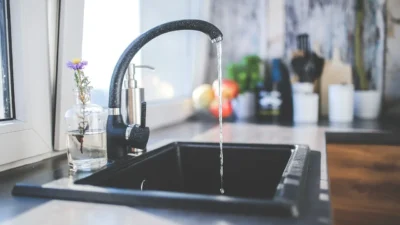
Advanced Tip: You can mix finishes, but do it with intention. A common approach is to choose one primary finish for all cabinet hardware and a different, complementary finish for lighting or the faucet. For example, matte black pulls with a brass faucet can look incredibly dynamic.
The Color & Material Context: What Are You Working With?
Your kitchen’s existing or planned elements—cabinets, countertops, backsplash, and fixtures—create the canvas. Your hardware should either harmonize with this palette or create an intentional, pleasing contrast. Here are key decision points for your hardware finish comparison.
Cabinet Color: Light cabinets (white, light gray) offer the most flexibility. Matte black creates high drama, brushed nickel offers a soft blend, and brass adds warmth. Dark cabinets (navy, black, charcoal) often pair best with a contrasting metal like brass or brushed nickel to prevent the hardware from disappearing.
Countertop & Backsplash: Look at the undertones. Cool gray marble with white veining? Brushed nickel will harmonize beautifully. Warm, creamy limestone or wood tones? Brass will enhance that warmth. A bold, colorful tile? Matte black can provide a grounding, neutral frame.
Existing Fixtures: While everything doesn’t need to match perfectly, consider the other metals in the room. A stainless steel sink or a chrome faucet has cool undertones that naturally pair with brushed nickel. An oil-rubbed bronze light fixture has warm undertones that lean toward brass. The goal is to avoid obvious clashes in undertone.
Common Hardware Finish Mistakes (And How to Avoid Them)
Even with the right finish, execution matters. Here are a few practical pitfalls to sidestep when finalizing your cabinet pulls finish ideas.
Mistake 1: Ignoring Scale and Proportion. A tiny knob on a large drawer looks lost and cheap. Solution: For large drawers and doors, use a longer pull or a larger knob. A good rule of thumb is that a pull should be about one-third the width of the drawer front.
Mistake 2: Clashing with Undertones. Mixing a warm brass with a cool chrome faucet without a deliberate plan can make a space feel unsettled. Solution: Stick to one undertone family (warm or cool) for the majority of metals, or ensure any mixed metals are separated by function and balanced visually.
Mistake 3: Forgetting About Practicality. If you hate cleaning fingerprints, a high-polish or flat matte black might frustrate you. If you dislike change, unlacquered brass may not be your friend. Solution: Choose a finish that suits your lifestyle. Brushed and satin textures are forgiving, while lacquered metals are low-maintenance.
Mistake 4: Blindly Following a Trend. Forcing a trendy finish into a kitchen with a conflicting style (e.g., matte black in a very traditional oak kitchen) can look disjointed. Solution: Let your kitchen’s inherent style guide you. Trends come and go, but cohesive design lasts.
Choosing Your Kitchen’s Signature Finish
In the debate of brushed nickel vs matte black vs brass, there’s no single “best” winner—only the best choice for your kitchen’s unique story. The most reliable path is to start with your dominant style, then filter that choice through the lens of your color palette and material landscape. Remember, hardware is the jewelry of the room; it should feel like a natural extension of the space’s personality, not an afterthought.
Trust the process: define your style, consider your context, and don’t be afraid to order physical samples. Seeing and touching the finishes in your own lighting against your cabinets is the ultimate test. Whichever path you choose, selecting it with this intentionality will give you confidence that your kitchen’s finishing touch is perfectly, personally yours.
Q: Can you mix brushed nickel and matte black hardware?
A: Yes, but do it strategically. A common and successful approach is to use one finish for all cabinet hardware (e.g., matte black pulls) and the other for lighting fixtures or the faucet (e.g., a brushed nickel faucet). This creates a layered, designed look without appearing random or messy.
Q: Is brass hardware going out of style?
A: Not at all. While its popularity has surged, brass has been a design staple for centuries. The key is choosing the right finish. Satin, unlacquered, or aged brass feels current and timeless, whereas highly polished brass can read as more dated. Its warmth offers a classic counterbalance to cool modern palettes.
Q: Which finish shows the fewest fingerprints and water spots?
A: Brushed nickel is typically the winner for hiding fingerprints and water marks. The textured, brushed surface diffuses light and minimizes the appearance of smudges. Matte black can show fingerprints on its flat surface, and polished brass or chrome will clearly show water spots.
Q: Should my cabinet hardware match my faucet exactly?
A: Not necessarily. While matching creates a cohesive, streamlined look, mixing metals is a popular design technique. The goal is cohesion, not uniformity. If you mix, ensure the finishes share a similar undertone (warm or cool) or are deliberately contrasted as a design feature, with one metal clearly dominating.